Nearly one in five players at this World Cup plays his club football in a shirt sold to a gambling brand. They played 41,006 minutes at the tournament, and at least one of them started 99 of the 104 matches. None of it was paid for by the tournament. Here is where the money actually went, and why the shirt front is the last part of it to go.
Spain lifted the World Cup on 19 July 2026. Somewhere, in a media-value spreadsheet, a betting brand called NET88 was quietly credited with a World Cup win. It is not technically wrong. Exactly one player in the champion squad, Yéremy Pino, on the pitch for 114 minutes, played his club football at Crystal Palace, whose shirt carried NET88. That is the entire footprint: one player, 1.4% of the minutes the world champions played, and a place in football history.
Gambling brands never bought a World Cup sponsorship. National kits carry no shirt sponsor — so brands bought domestic shirt deals instead, and World Cup 2026 arrived free on top.
We matched all 1,248 players at the tournament to their club, and 397 of the 451 clubs to the shirt front it was wearing on the day it kicked off. Gambling-sponsored players started 95% of the matches, and almost none of them played for the team that actually won it.
The findings
223 of the 1,248 players (17.9%) play for a club whose shirt front is sold to a betting brand. Nearly one in five.
41,006 minutes of World Cup football played by gambling-sponsored players. 19.4% of the whole tournament.
The champions were clean. Spain won with 1 of 26. Argentina, beaten in the final, had 6.
Betano was the biggest buyer. Its clubs sent 39 players who played 7,034 minutes, 2.4 times the next brand and more players than any single country brought. It finished without a winner's medal.
NET88 scored the most goals (8) off 12 players at 1 club.
Hollywoodbets were the dirtiest at 0.434 cards per 90 minutes played, roughly one card every two full matches. Betano led on raw card count only because it had the most players.
Only 3 of the 49 betting brands in the dataset had eleven players at the tournament, enough to field a team at all.
Kaizen Gaming, the Greek operator behind both Betano and Stoiximan, had 43 players between the two brands, 3.3 times the next owner. Counted brand by brand, the industry's largest player disappears.
Asia, Africa and Oceania: zero. Of the 250 players at clubs in those three confederations, we identified the shirt sponsor for 188, and not one carries a betting brand. South America runs at 63.9%.
A World Cup minute cost the sponsoring brand between £3,449 and £5,562, across the three deals whose fees are public and reported in sterling. Nobody set out to buy World Cup minutes; they came free with a domestic season.
19 of the 75 deals expire in 2026, and 13 are at English clubs. Eight of those are Premier League clubs, which is every top-flight club carrying a gambling brand on its shirt front. The shirt front does not happen again. The sleeve does.
The winner's medal nobody planned
Sponsorship is sold on reach, and reach is sold on the assumption that the biggest brands attach themselves to the biggest teams. World Cup 2026 says otherwise. The champions carried 114 minutes of betting exposure across the entire tournament, 1.4% of the 8,250 minutes Spain played. Four other brands did reach the final, all of them on Argentina's losing shirts.
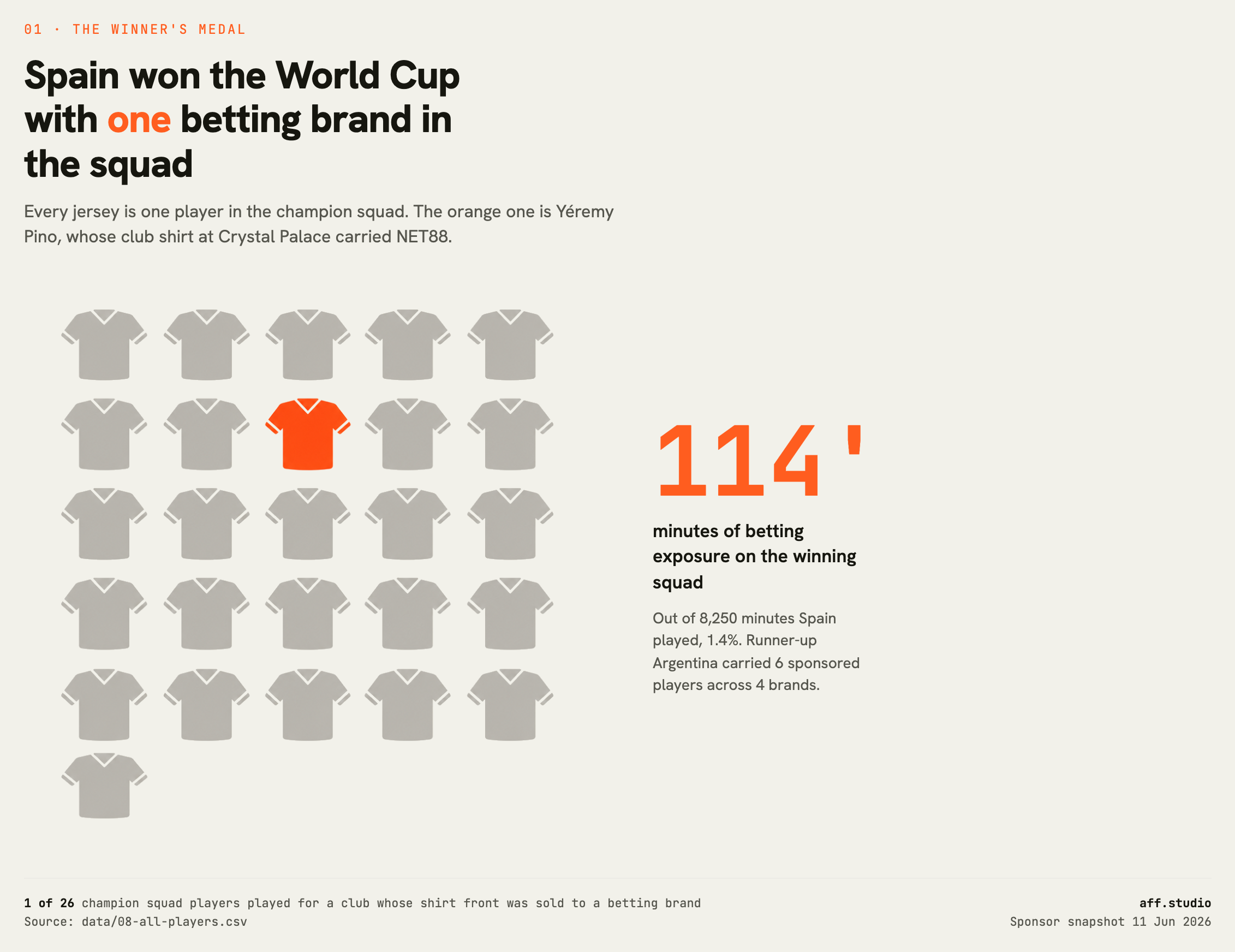
Every jersey is one player in the champion squad. 1 of 26 played for a club whose shirt front was sold to a gambling brand.
NET88's deal with Crystal Palace was reported at £10m a season. It sponsors exactly one club, and that club sent 12 players to the World Cup from 10 different countries. The medal was a bonus nobody underwrote.
Who bought the most football
Gambling-sponsored players turned out for 41 of the 48 squads and delivered 41,006 minutes, 19.4% of every minute played at the tournament. Judged purely on time on the pitch, no industry had more of this World Cup running for it, and not one brand paid the tournament a penny for it.
Betano owns that leaderboard outright: 7,034 minutes from 39 players across 8 clubs and 17 nationalities. That is 2.4x the next brand, and more players than any single country brought.
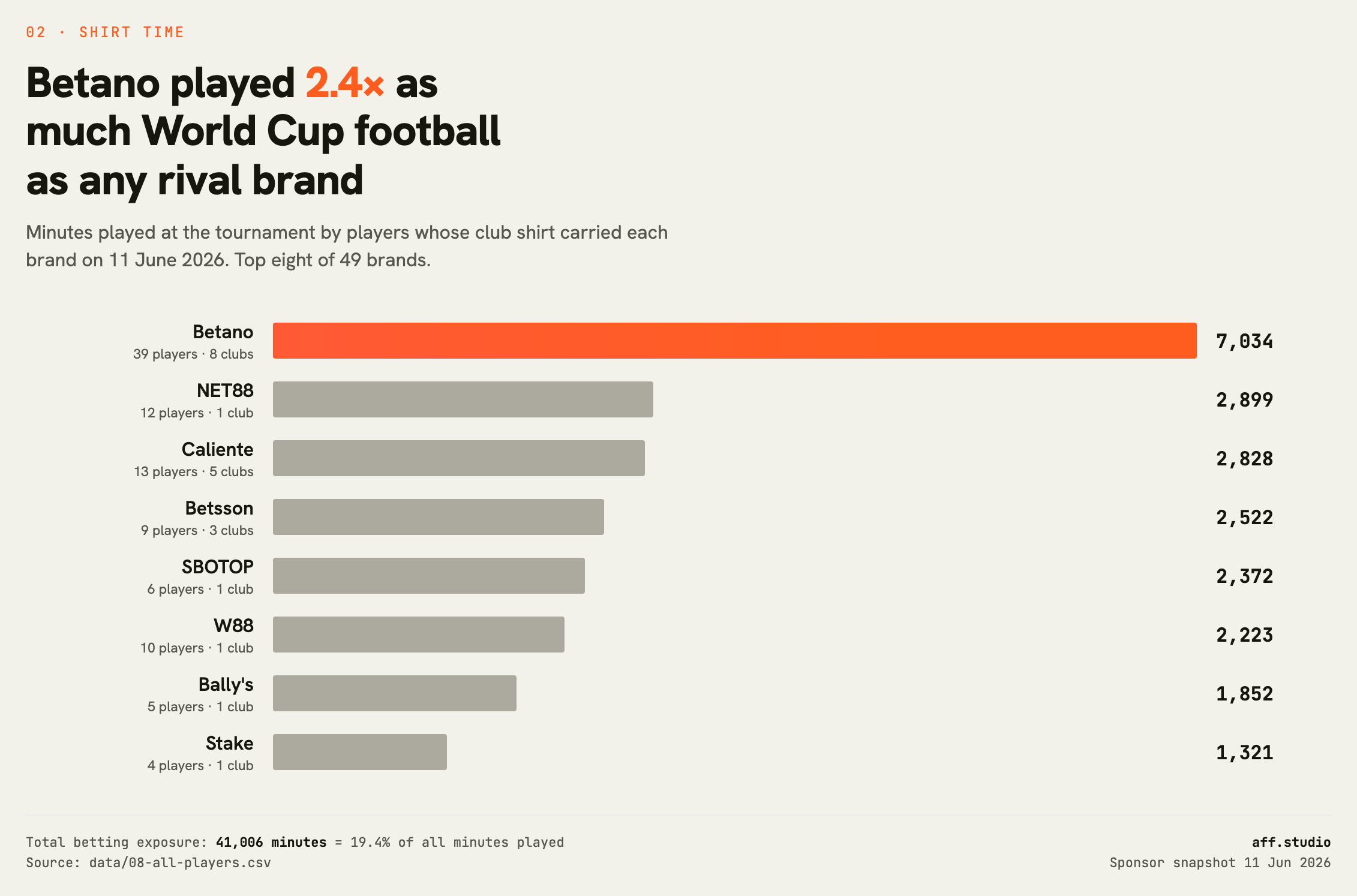
Minutes played by brand. Betano's 7,034 is 2.4x the next largest.
The goal table
Volume and output are not the same purchase. NET88 top the scoring table with 8 goals from 12 players at a single club. Betano, with more than three times the squad, managed 6. Per player, NET88 outscored it by a factor of 4.3.
Brand | Players | Minutes | Goals | Assists | Cards | Cards / 90 |
|---|---|---|---|---|---|---|
Betano | 39 | 7,034 | 6 | 6 | 9 | 0.115 |
NET88 | 12 | 2,899 | 8 | 2 | 3 | 0.093 |
Caliente | 13 | 2,828 | 1 | 4 | 2 | 0.064 |
Betsson | 9 | 2,522 | 3 | 4 | 4 | 0.143 |
SBOTOP | 6 | 2,372 | 3 | 1 | 5 | 0.19 |
W88 | 10 | 2,223 | 7 | 1 | 4 | 0.162 |
Bally's | 5 | 1,852 | 2 | 4 | 1 | 0.049 |
Stake | 4 | 1,321 | 1 | 2 | 0 | 0.0 |
Dafabet | 8 | 1,188 | 2 | 0 | 1 | 0.076 |
Sportingbet | 7 | 1,152 | 2 | 1 | 2 | 0.156 |
Top 10 brands by World Cup minutes, of 49 in the dataset. Cards per 90 minutes shown only for brands whose players logged at least 500 minutes between them.
The most brutal brand
Betano collected the most cards of any brand (9), but it also had the most players. That is squad size, not aggression. Rate it per 90 minutes played, counting only brands whose players logged at least 500 minutes between them so a single booking cannot top the table, and the leaderboard inverts: Hollywoodbets at 0.434 cards per 90, 3.8 times Betano's rate.
The title is worth less than it sounds. The dirtiest brand at the World Cup is four Brentford players who collected three yellow cards between them. The tournament produced 13 red cards in total and exactly one went to a betting sponsored player. If you came for carnage, the shirts are clean.
The Ultimate XI
Take the 181 sponsored players who recorded World Cup minutes, of the 223 in the dataset, rank them on their tournament performance, and a genuinely strong side falls out: 8 nationalities, 7 clubs, 6 rival gambling brands in one dressing room. Between them, 14 goals and 10 assists.
Ismaïla Sarr of Crystal Palace leads the line: his 4 goals were the most of any betting sponsored player at the tournament, and half of everything NET88 got for its money. Behind him Emiliano Martínez played 810 minutes, more than any other sponsored player at the tournament, and Lautaro Martínez added 2 goals and 1 assist on the way to the final.
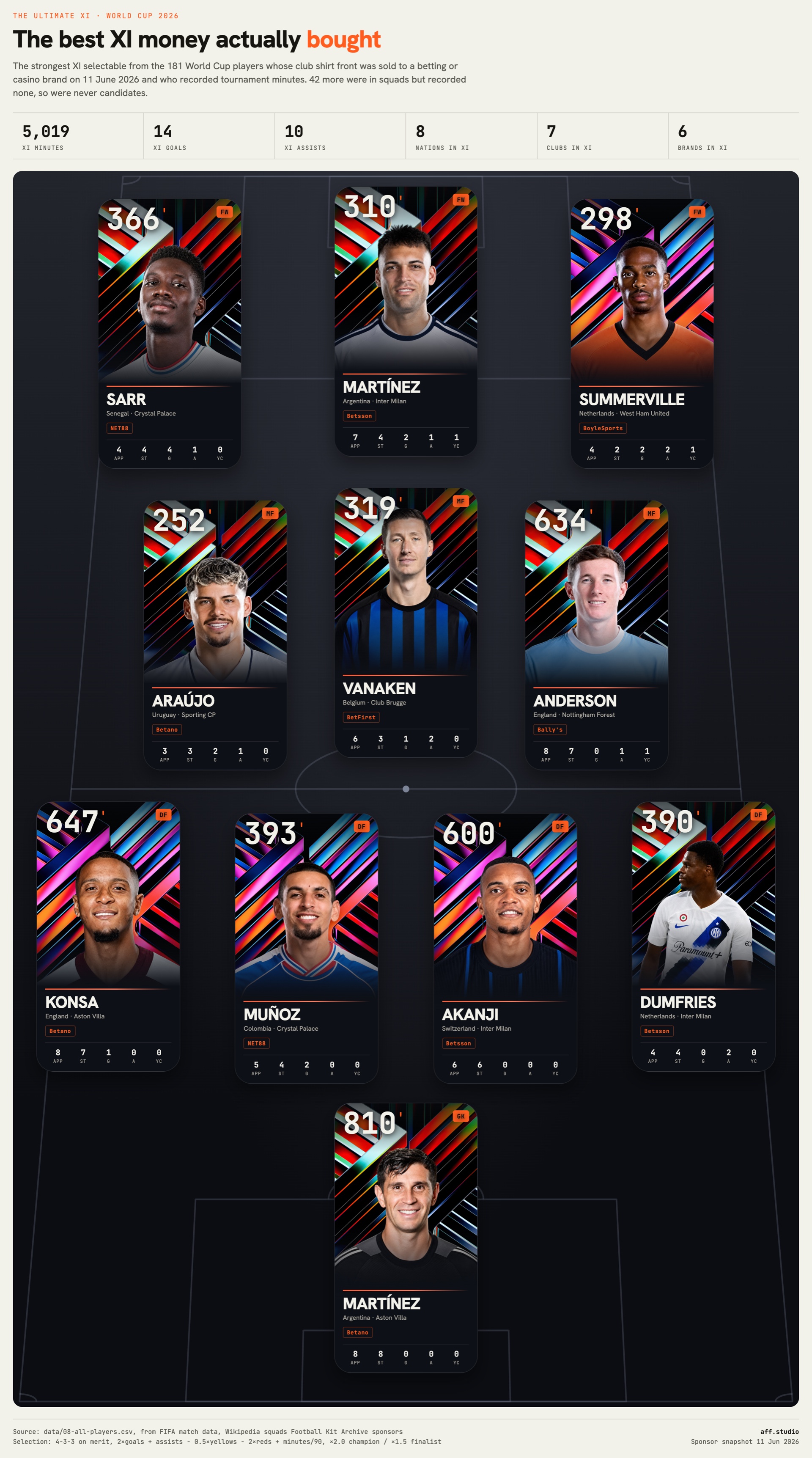
The Ultimate XI, the strongest side selectable from the 181 betting sponsored players who recorded minutes at World Cup 2026.
Betano United
Most brands cannot do this. Only 3 of the 49 betting brands (Betano, NET88, Caliente) had eleven players at the World Cup at all. Betano is the only one with a real bench: 39 players across 8 clubs and 17 nationalities.
Its best XI spans 10 countries and, on closer inspection, largely one training ground in Birmingham: 7 of the 11 are Aston Villa players. Buying reach across 8 clubs still concentrates your best football in three of them.
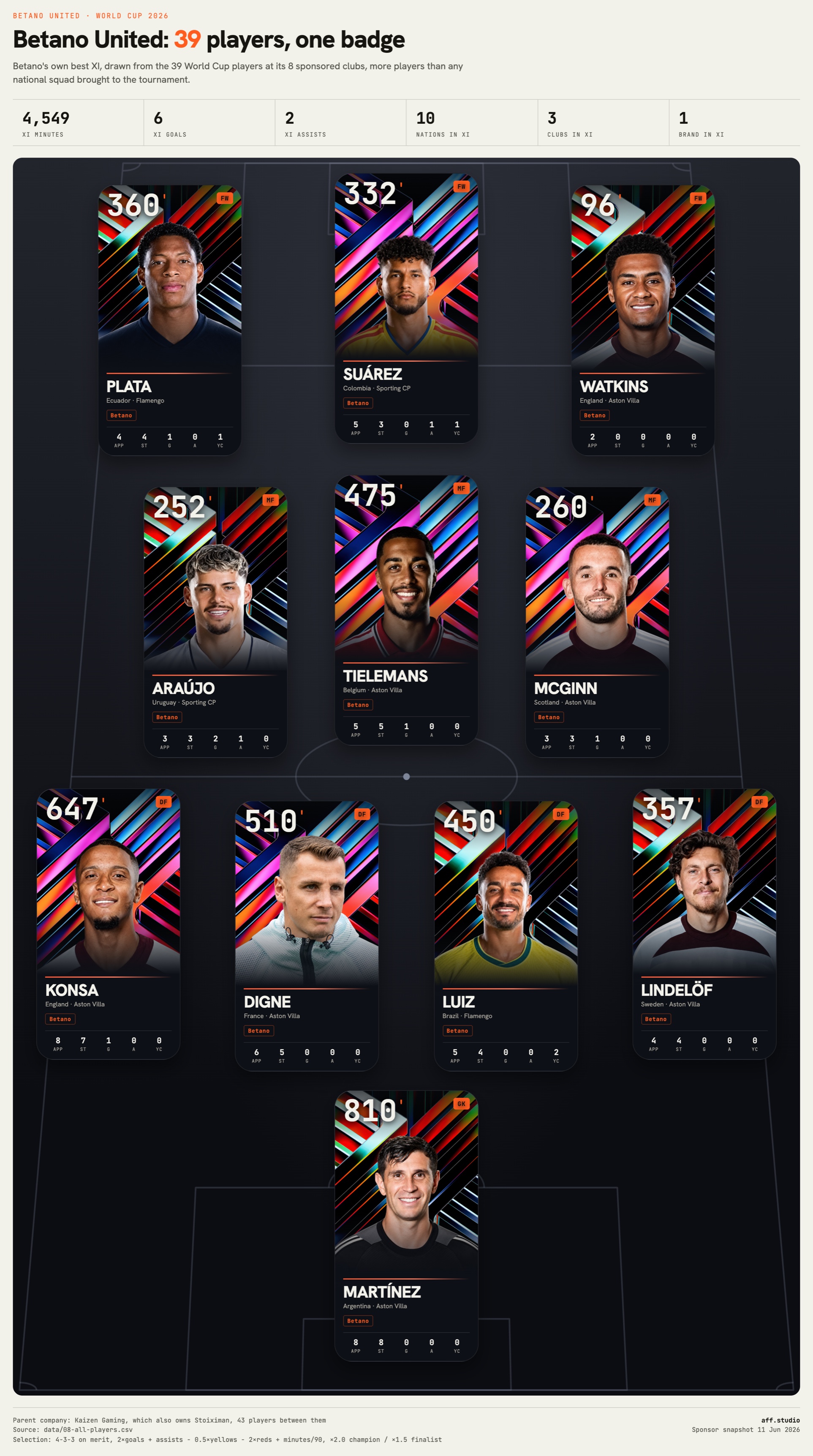
Betano United, the best XI from Betano's 39 World Cup players.
What 39 players actually bought
Put the two teams side by side. Betano holds 17.5% of every betting sponsored player at the tournament and supplies 27.3% of the Ultimate XI, 3 of 11. On quality per player, its roster is ahead of the market.
Ultimate XI | Betano United | |
|---|---|---|
Goals | 14 | 6 |
Assists | 10 | 2 |
Minutes | 5,019 | 4,549 |
Starts | 52 | 46 |
Nationalities | 8 | 10 |
Clubs | 7 | 3 |
Brands | 6 | 1 |
The best XI drawn from all betting sponsored players, against the best XI one brand can field on its own.
And then the bill arrives. The best team the whole industry can field scores 2.3x the goals of the best team its biggest spender can field, and 5x the assists. What Betano's 39 players bought was reach: 17 nationalities across 8 clubs, and a best XI spanning 10 countries against the Ultimate XI's 8. Goals were never on sale. No sponsor can buy those, and Betano bought more of the thing that was actually for sale than anyone else. But spread across 8 clubs, the good football still concentrated in three.
Both squads ship as an interactive graphic with this study, with the full record for every player.
The derbies nobody noticed
62 of the 104 matches at this World Cup had a betting sponsored player in both starting XIs. Nobody has published a betting brand head to head before, because nobody had the join. Two brands spent a World Cup playing each other and neither could have planned it.
Fixture | Matches |
|---|---|
Betano v W88 | 9 |
Betano v NET88 | 8 |
Betano v SBOTOP | 8 |
Betano v Betsson | 7 |
Brand against brand, counted on starting lineups across all 104 matches.
Betano met W88 9 times in six weeks, more often than most club rivalries manage in a season. And because Betano had starters in 55 of 104 matches, it kept running into itself: in 8 fixtures the same brand was on both sides, 9 occasions in all because one of those fixtures did it twice over with two different brands. 4 were Betano against Betano. A brand that cannot lose, and cannot win.
Only 5 of the 104 matches had no betting-sponsored player in either starting lineup. In the other 99, 95% of the tournament, a player whose club shirt is sold to a betting brand was on the pitch from kickoff.
Where betting is allowed on a shirt, and where it is not
Split the players by the confederation of the club they play for, not by their own nationality, and the picture stops being about marketing budgets and starts being about law. CONMEBOL clubs ran at 63.9%, UEFA at 20.5%, CONCACAF at 18.2%. AFC, CAF and OFC returned a clean zero across the 188 players whose club sponsor we could identify. Those clubs are not missing from our data. They have sponsors on file, and they sell their shirt fronts to banks, telecoms and airlines instead. A further 62 players in those three confederations play for clubs the source has no page for at all; we count those as unknown rather than assume a zero.
A market this poor should not produce this pattern. South American leagues earn a fraction of what European ones do, so if betting money followed spending power the ranking would run the other way. And the zero is not a low number, it is an absolute one, holding across 188 players and three confederations. Markets almost never produce clean zeros. Law mostly does.
That is what makes this the most useful comparison in the study. The Premier League's shirt fronts go betting-free in 2026/27 and nobody knows what replaces the money. The answer is already on the pitch. In every market where gambling advertising is restricted, the shirt front went to a bank, a telecom or an airline. The post-ban Premier League shirt exists today, and it is being worn in Tokyo, Cairo and Riyadh. What this dataset cannot tell you is what those sponsors pay.
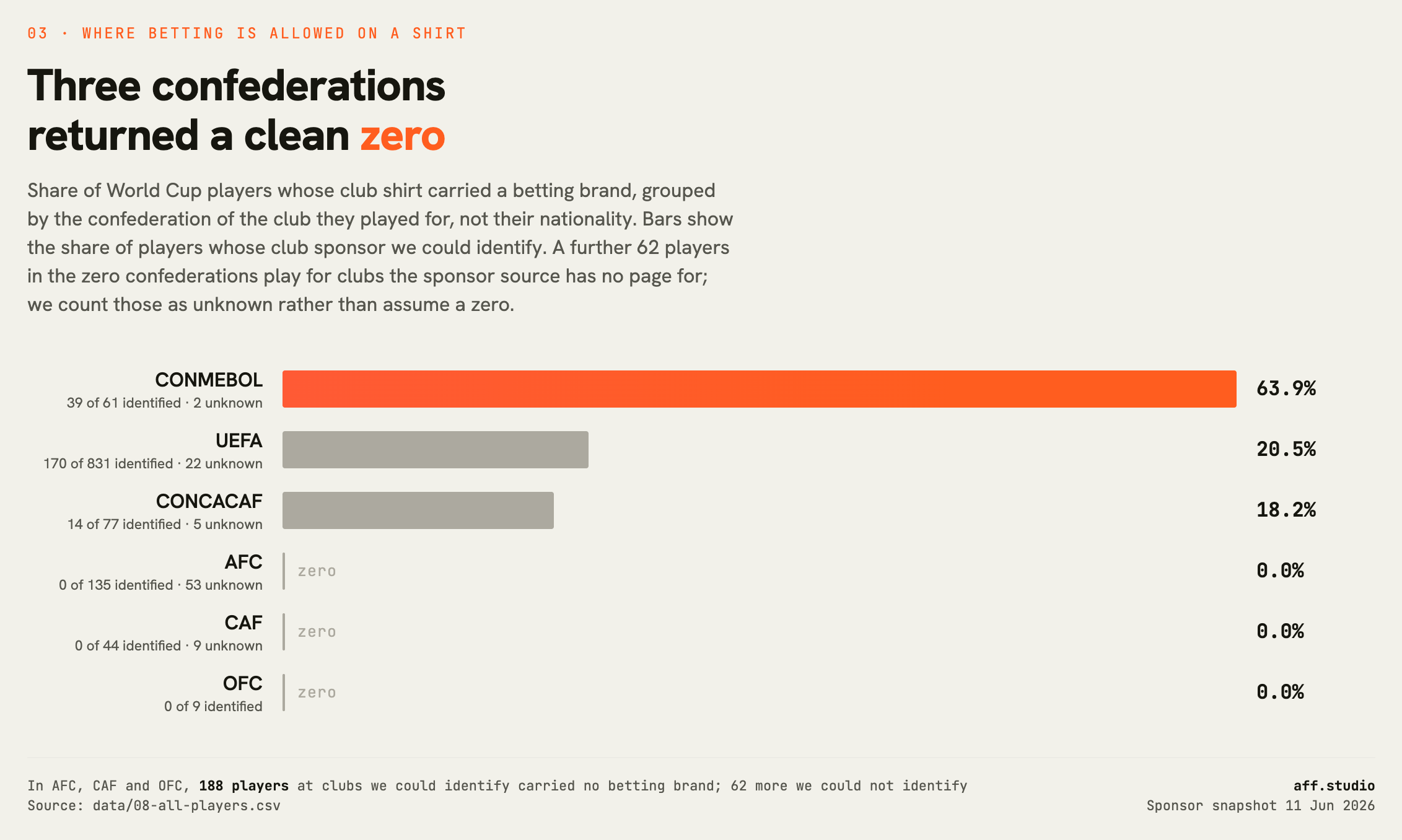
Share of World Cup players whose club shirt front was sold to a betting brand, by the confederation of their club.
What a World Cup minute cost
Only four of the 75 deals in this dataset have a publicly reported fee. Divide the reported season fee by the World Cup minutes that club's players actually delivered and you get what a World Cup minute cost the brand paying for it. Among the three deals reported in sterling, so like for like: £5,562 per minute for Betano at Aston Villa, down to £3,449 for NET88 at Crystal Palace. Betsson at Inter Milan is reported in euros, at €14,970 a minute, and cannot go on the same scale. Nobody bought World Cup minutes on purpose. They bought a domestic season, which is exactly why nobody has priced this before and why standard sponsorship measurement misses it.
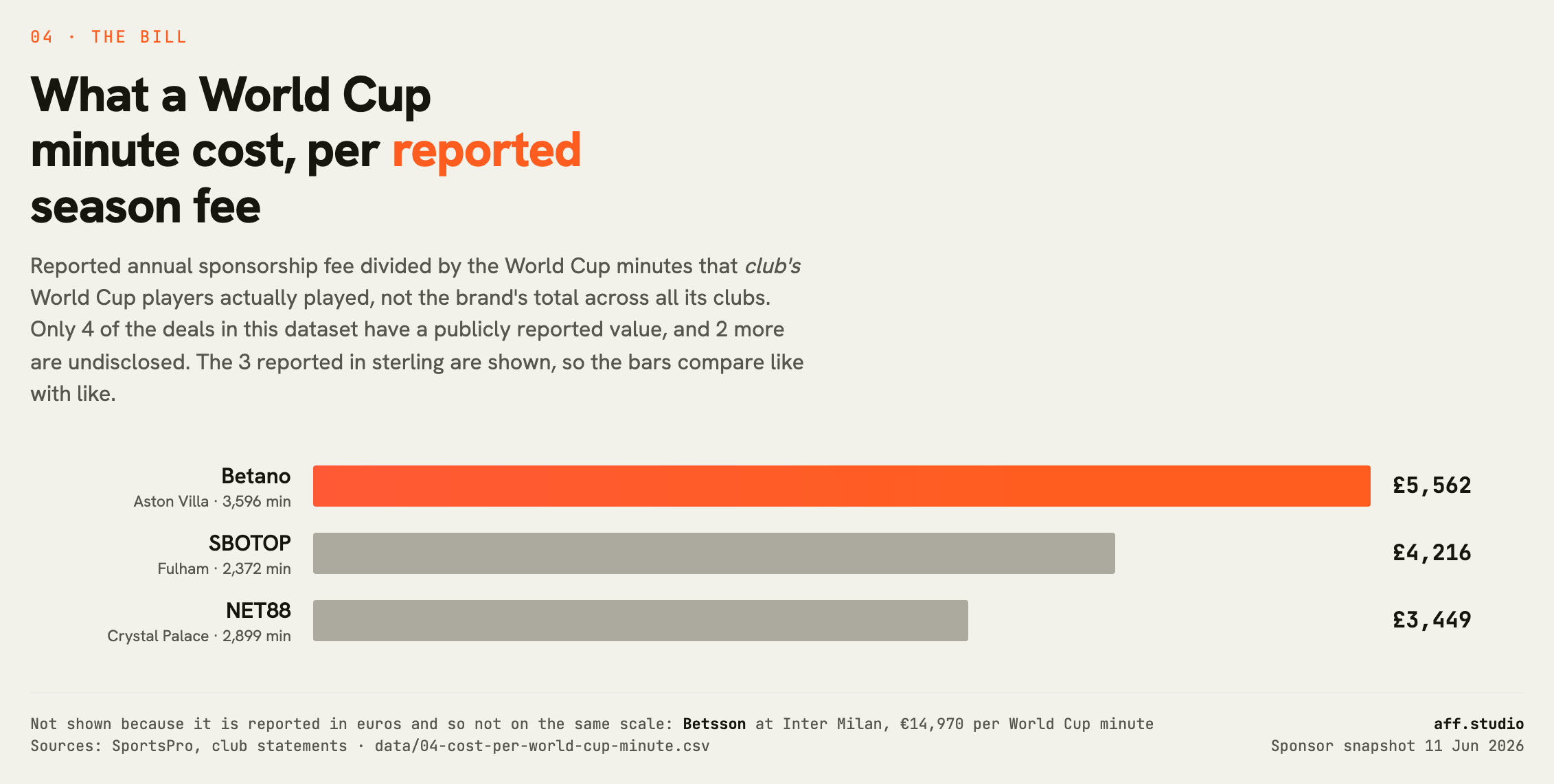
Cost per World Cup minute for the 3 deals reported in sterling. Betsson at Inter Milan is reported in euros and is noted separately rather than drawn on the same scale.
Club | Brand | Reported fee | Per WC minute at this club | Per WC player at this club | Per WC goal at this club |
|---|---|---|---|---|---|
Inter Milan | Betsson | €30,000,000/season | €14,970 | €4,285,714 | €10,000,000 |
Aston Villa | Betano | £20,000,000/season | £5,562 | £2,222,222 | £6,666,667 |
Fulham | SBOTOP | £10,000,000/season | £4,216 | £1,666,667 | £3,333,333 |
Crystal Palace | NET88 | £10,000,000/season | £3,449 | £833,333 | £1,250,000 |
Every per-unit figure is scoped to that club's own World Cup players, not to the brand across all of its clubs: Aston Villa supplied 3 of Betano's 6 goals. Reported fees are as published by SportsPro and club statements, and are not currency adjusted.
That last column is the one to sit with. Among the three deals reported in sterling, so like for like with no currency conversion, a World Cup goal cost NET88 £1,250,000 at Crystal Palace and Betano £6,666,667 at Aston Villa. That is a 5.3 times spread on the same asset, in the same tournament, in the same six weeks. Betsson at Inter Milan, reported in euros and so not directly comparable, sits dearer still at €10,000,000 a goal. There is no benchmark to judge any of this against, because nobody was buying World Cup minutes deliberately, and a market that prices the same thing 5.3 times apart has not worked out what it is buying.
The last World Cup with betting on a Premier League shirt front
19 of the 75 deals in this dataset expire in 2026, and 13 are at English clubs. Eight of those are Premier League clubs, which is every single top-flight club carrying a betting brand on its shirt front. Not one English betting deal that runs past 2026 belongs to a Premier League club. The Premier League's clubs have agreed to remove betting brands from shirt fronts from 2026/27, the season immediately after this tournament, against the backdrop of the UK's gambling white paper and a tightening line from the Gambling Commission. Several other markets are moving the same way, and the ban is already visible in the contract end dates.
Which makes this a closing record for one thing only. The next World Cup will not have a Premier League club carrying a betting brand on its shirt front — but Betano has already moved to Aston Villa's sleeve, and the ban covers the front and nothing else. It covers only the Premier League, too: English clubs below it are not bound by it.
Nine weeks later: a third of it has already gone
Everything above is fixed to 11 June 2026 and does not move. This chapter is a second, separately dated observation: the same 223 players, re-checked after the summer transfer window closed on 1 September 2026, against the shirts their clubs carry in 2026/27.
Of the 223 players whose club shirt was sold to a betting brand in June:
95 are still at a club carrying the same brand, worth 14,868 World Cup minutes.
20 are at a club carrying a different betting brand, worth 2,651 minutes. 11 of them moved club; the other 9 stayed put while their club changed sponsor.
55 moved to a club with no betting sponsor, taking 11,713 minutes off betting shirts.
48 never moved, but the brand came off the shirt around them, worth 10,846 minutes.
5 are at clubs that publish no sponsor at all, worth 928 minutes, counted as unknown rather than as zero.
The two ways of losing visibility are almost the same size and mean opposite things, and only the first is a transfer. 38 of those 48 play for the eight Premier League clubs that carried a betting brand in June: Aston Villa, Bournemouth, Brentford, Crystal Palace, Everton, Fulham, Nottingham Forest and Sunderland. Every one of them now sells its shirt front to something else, from Visit Rwanda to ClickHouse. NET88 lost 2,266 World Cup minutes at Crystal Palace and W88 lost 2,223 at Sunderland without a single one of their players moving anywhere.
Traffic ran the other way too, and the industry bought some of the loss back. 42 players moved onto a betting shirt, carrying 8,262 World Cup minutes with them, and 7 more stayed where they were while their club took a betting sponsor on, worth 965 minutes. Roma signed Eurobet, a brand with no World Cup players at all in June, and now carries 1,371 of them. Club Brugge swapped BetFirst for Betsson.
Net, betting brands went from 41,006 World Cup minutes to 26,746, a fall of 14,260, or just over a third. The number of brands with a World Cup player on the shirt fell from 49 to 38: 18 of the original 49 have none left, and 7 brands that had none in June now have one.
Brand | June | Kept | Lost | Unresolved | Gained | Now |
|---|---|---|---|---|---|---|
NET88 | 2,899 | 0 | 2,899 | 0 | 0 | 0 |
Betano | 7,034 | 2,736 | 4,173 | 125 | 1,725 | 4,461 |
SBOTOP | 2,372 | 0 | 2,372 | 0 | 0 | 0 |
W88 | 2,223 | 0 | 2,223 | 0 | 0 | 0 |
Bally's | 1,852 | 0 | 1,852 | 0 | 0 | 0 |
Betsson | 2,522 | 2,132 | 390 | 0 | 2,391 | 4,523 |
Eurobet | 0 | 0 | 0 | 0 | 1,371 | 1,371 |
Stoiximan | 407 | 147 | 0 | 260 | 1,528 | 1,675 |
Midnite | 342 | 0 | 342 | 0 | 1,120 | 1,120 |
Superbet | 525 | 459 | 66 | 0 | 473 | 932 |
World Cup minutes. Kept plus Lost plus Unresolved equals June. Kept plus Gained equals Now. Five biggest falls, then five biggest rises. Source: data/09-transfer-ledger-by-brand.csv.
Read against the minutes table earlier in this document, the reshuffle is the whole story. Betano's lead is gone. Betano ends the window on 4,461 World Cup minutes, down from 7,034 in June. Betsson now has 4,523. The gap between them is narrower than the 125 minutes Betano still has unresolved, so the two are level rather than reordered. Consolidating by owner no longer rescues the group either: Betano and Stoiximan together fall from 7,441 minutes to 6,136.
One thing the window did not do is hand brands much free exposure. Only 5 players, worth 654 World Cup minutes, joined betting sponsored clubs that had sent nobody to the tournament at all.
26,746 is a floor rather than a ceiling. 124 players, worth 12,107 minutes, are now at clubs that publish no shirt sponsor, and are counted as unknown throughout, never as zero.
What this means
The industry has two scoreboards and they rank the buyers in opposite orders. By reach, Betano won at a distance: the most players, the most minutes, and a presence in 17 of the 48 squads. By silverware, NET88 sponsored a single club and got a winner. Nobody has agreed which scoreboard counts, which is part of why the same asset prices 5.3 times apart.
Scale buys reach, and reach is the only thing on sale. Betano's 39 players across 8 clubs covered 17 nationalities, more countries than the industry's own best XI reached. They scored less than half its goals, because no sponsor has ever been able to buy goals.
One company controlled more of this World Cup than any brand table shows. Kaizen Gaming's two brands, Betano and Stoiximan, covered 43 players between them, 19% of every betting-sponsored player at the tournament. Read brand by brand, the biggest holding in the industry is invisible.
The post-ban shirt already exists. Where gambling advertising is restricted, shirt fronts carry banks, telecoms and airlines instead, across 188 players and three confederations. Anyone asking what replaces betting money on a Premier League shirt can look at Tokyo, Cairo and Riyadh. What this dataset cannot show is what those sponsors pay.
The window is closing, and it is closing faster than anyone priced. One transfer window took betting brands from 41,006 World Cup minutes to 26,746, just over a third of the shirt-front visibility gone in nine weeks. Of the 22,559 minutes that came off betting shirts, 10,846 went because the brand left the shirt rather than because the player left the club. Anyone modelling shirt sponsorship value in regulated markets should read this as one window measured twice, not a trend, and should remember it counts shirt fronts only.
If gambling advertising is part of your business, the useful question is not how much reach a shirt buys. It is how much of that reach survives the next regulatory cycle.
Methodology
Squads for all 48 teams (1,248 players) come from Wikipedia. Match statistics, covering appearances, starts, minutes, goals, assists and cards across all 104 matches, come from FIFA's official competition API. Front of shirt sponsors come from Football Kit Archive, used with the site owner's permission, read as dated history and frozen to a single snapshot: 11 June 2026, the day the tournament kicked off. Sponsors count as gambling brands whether they run a sportsbook, a casino, or both; "betting brand" is used as shorthand throughout. Players are joined to match data on nation and shirt number rather than name. Sponsor data was resolved for 397 of 451 clubs (88.0%); the remainder have no page on the source and are reported as unknown rather than as zero, so 223 is a floor. Minutes follow the standard convention of 90, or 120 where a match went to extra time, and are not extended for stoppage time. Only front of shirt placements are counted, with no sleeve or back of shirt deals. League membership, used only to count how many of the expiring English deals sit at Premier League clubs, comes from the same sponsor source's own league index and ships in data/06-club-brand-deals.csv. Every figure in this article is generated directly from the published dataset. The single snapshot has one deliberate exception: the September chapter is a second and separately dated observation of the same players, taken after the transfer window closed on 1 September 2026, with current clubs from Wikipedia and 2026/27 shirt sponsors read as dated ranges from the same sponsor source. It is reported alongside the snapshot and never folded into it. The full method note ships with the data package.